Published at ASME International Design Engineering Technical Conferences (IDETC-CIE), Charlotte, NC, 2016.
Authors: Leya B. Baltaxe-Admony, Ash Robbins, Erik A. Jung, Steven Lessard, Mircea Teodorescu, Vytas SunSpiral, Adrian Agogino
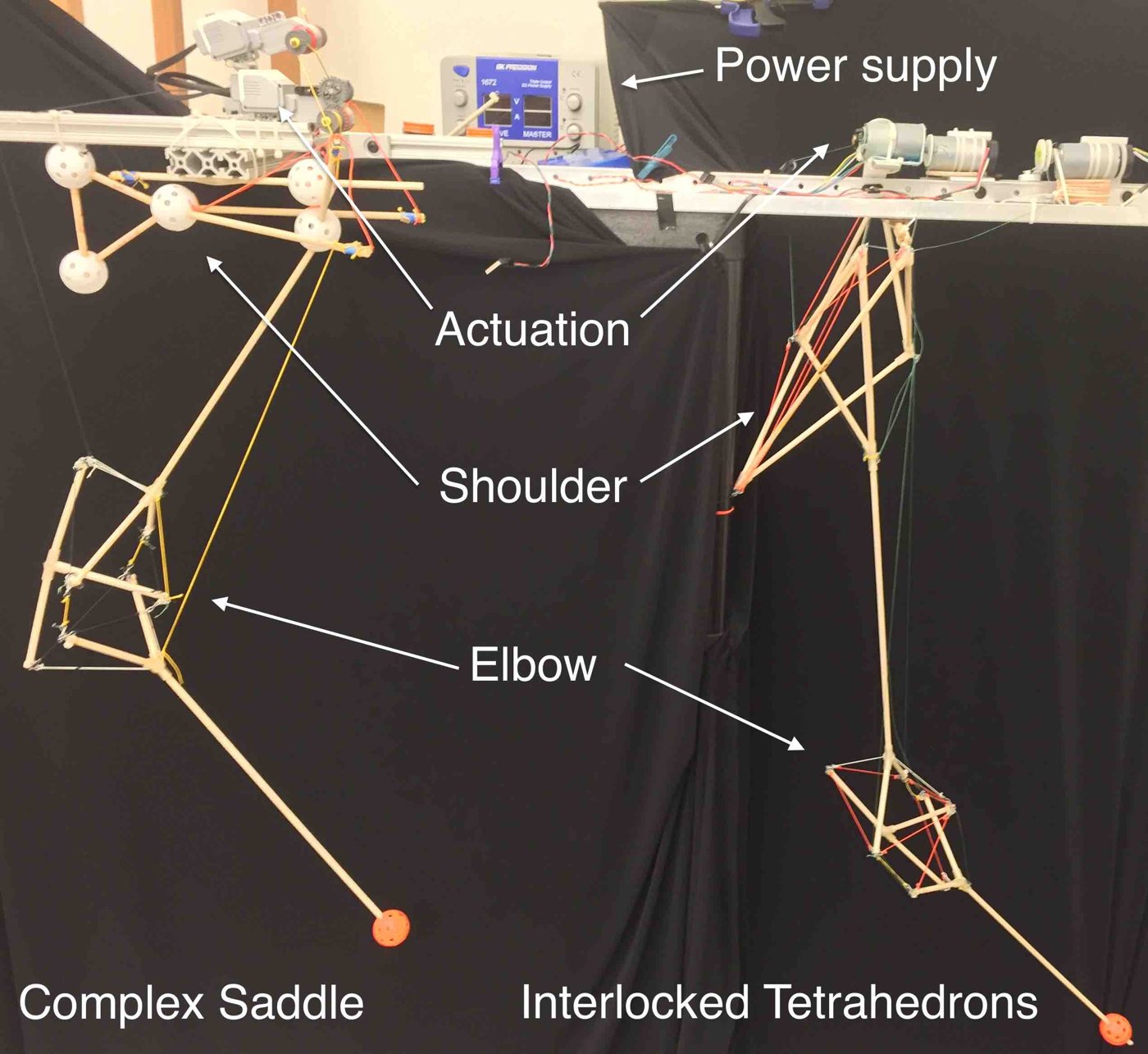
Your shoulder doesn't turn around one hinge the way a robot joint does. It's a few bones held together by muscle, tendon, and ligament, and that soft tissue is a big part of why it can move so freely. We wanted to see if a tensegrity structure could do something similar. Tensegrity is a way of building where rigid struts are held in place by a web of cables under tension.
We designed four versions: a simple saddle, a complex saddle, a suspended tubercle, and a set of interlocked tetrahedrons. Some move more, some are more stable, some are easier to drive with cables, and some look more like real anatomy. None of them win at everything.
In all of them, the elastic parts stretch under load, so force spreads through the whole joint instead of landing on one bearing. Pulling on the cables changes where the joint points and how stiff it is at the same time. We also built a model so we could compare the designs side by side.
This was my first paper. Looking back, it's where the question I keep coming back to started. Can a joint get its give from how it's built, instead of from a motor bolted to an axle? The exosuit, the printed finger, and the ligament joints all grew out of that.