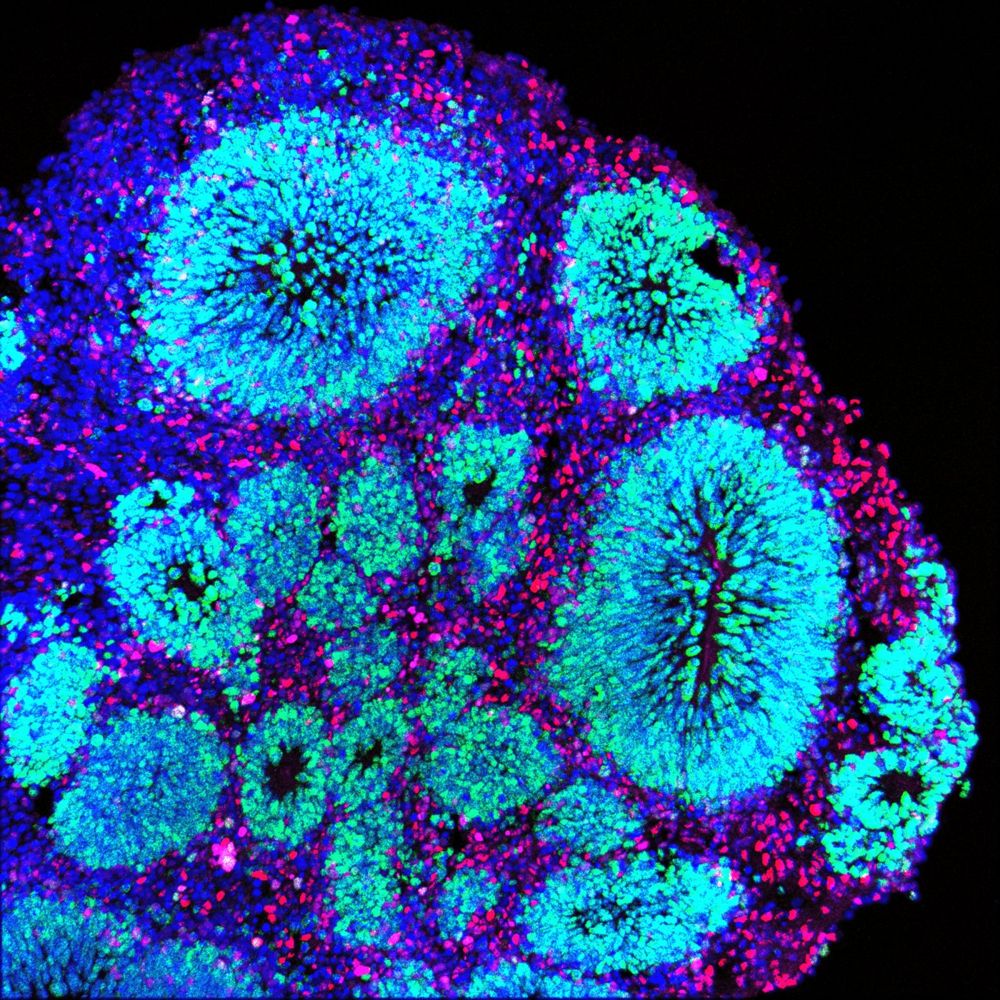
With the Braingeneers lab at UC Santa Cruz, I led a project asking whether cortical organoids can learn a goal-directed task. Organoids are little clumps of brain tissue grown from stem cells, about the size of a peppercorn. It turns out they can get better at a task if you coach them the right way.
We published it in Cell Reports in February 2026, "Goal-directed learning in cortical organoids".
The setup
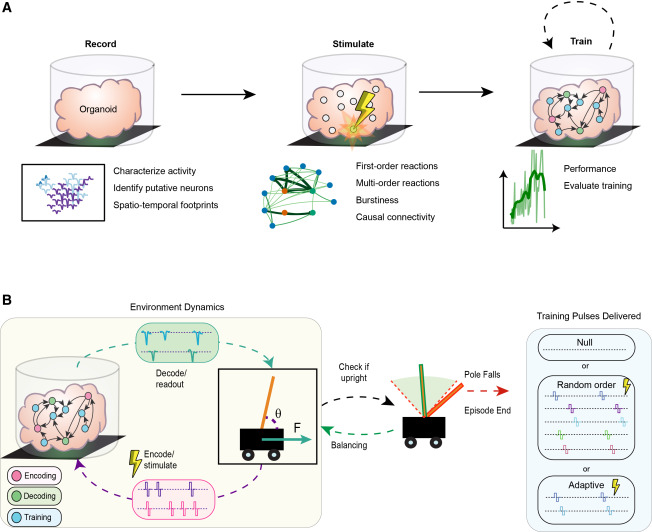
We gave the organoids cartpole, the old balance-a-pole-on-a-cart problem people use to test reinforcement learning agents. Each organoid sat on a multi-electrode array (MEA), which let us both listen to it and stimulate it. The pole's angle was turned into stimulation at different frequencies and sent to a set of input neurons. We decoded spikes from other neurons and used them to push the cart.
When an organoid wasn't improving, we sent training pulses to a separate group of neurons to nudge the network somewhere better. A reinforcement learning algorithm chose which training pulses to send.
What happened
With our adaptive training, the organoids hit a 46% success rate. With random stimulation they got 4.5%. So living tissue can be trained to do something structured, and we have a clean way to measure whether it's learning.
I once had Geoffrey Hinton play a game of pong against an organoid, and we got to argue about how best to train it.
Where this could go
If we can ask "does this tissue learn?" and get a clear answer, we can ask the same thing of tissue from a disease model. That's the bigger goal. Organoids could help us study Alzheimer's, Parkinson's, autism, and other conditions where learning might work differently.
BrainDance
I also built BrainDance, an open-source tool for running closed-loop learning experiments like this one. Biologists can use it to run experiments and analyze results without writing the hardware interface, training environment, games, and experiment code from scratch.
If you want to try a toy version of the experiment, it's on the Play page.