Published at the International Conference on Ubiquitous Robots (UR), 2020.
Authors: Maryam Tebyani, Ash Robbins, William Asper, Sri Kurniawan, Mircea Teodorescu, Zhongkui Wang, Shinichi Hirai
Most robot hands that copy human anatomy are built from a pile of parts. Bones get machined one at a time, tendons are string, ligaments are springs, and then someone spends a long time putting it all together. We used a multi-material 3D printer to make a whole finger in one go. Bones, ligaments, stretchy tendons, and the artificial muscles that pull on them all come off the printer already assembled.
What's in it
We picked out the main tendons and ligaments of the human index finger and modeled them in Fusion 360. The printed finger has:
- the three finger bones (proximal, middle, and distal phalanges)
- annular pulleys A2 through A5, the little sheaths that hold tendons against the bone
- volar plates and collateral ligaments, which keep the joints stable
- the FDS and FDP flexor tendons, which bend the finger
- the common extensor tendon, which straightens it
- articular cartilage to cushion the joints
Testing it
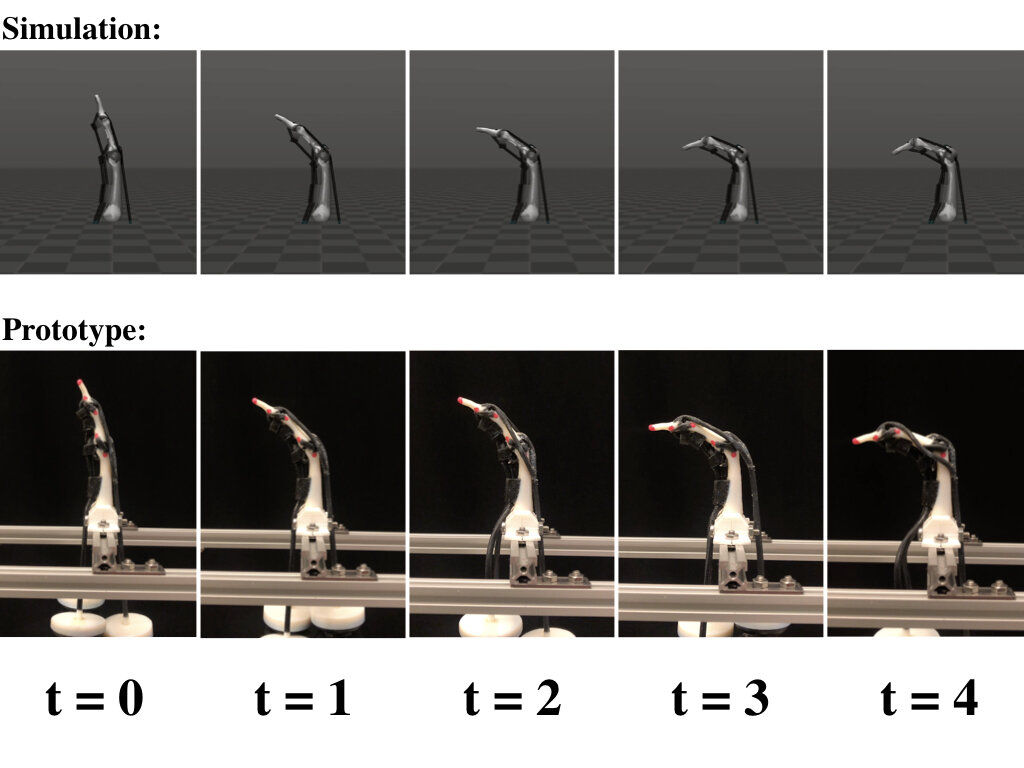
We also built the finger in MuJoCo, a physics simulator, and compared it to the printed one. Soft parts that stretch unevenly are hard to simulate, so we wanted to know how close the sim actually got.
Why one piece
The hardest part of building a hand like this is where things connect. Every spot where bone meets ligament or tendon meets muscle needs an attachment that holds without getting in the way. Printing the whole finger at once mostly skips that problem.